iDSL - Intelligent Digital Systems Lab

Projects

The projects behind our work in machine learning, computer vision and robotics, by research area.

Projects from our three research areas. Funders are not recorded for these.

Flagship output

fpgaConvNet

2016 – present

Mapping convolutional neural networks onto FPGAs

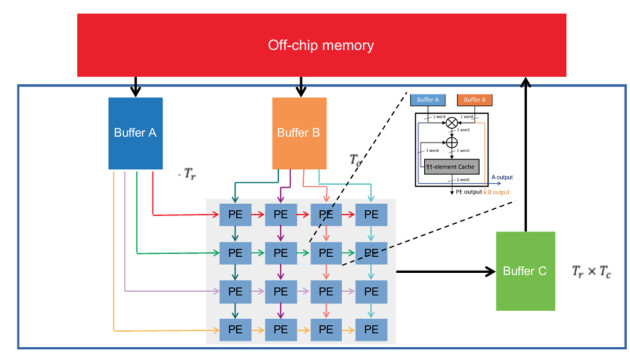
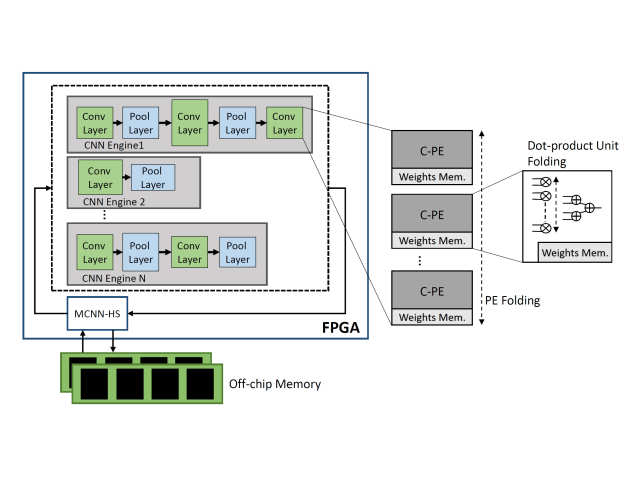
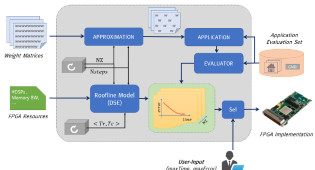
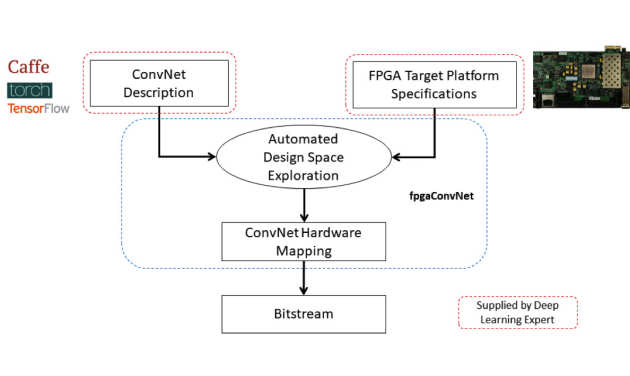
ConvNets deliver state-of-the-art accuracy from object detection to image captioning, and FPGAs are an attractive platform for them, but mapping a network onto an FPGA normally requires hardware design expertise and familiarity with specialised toolchains. fpgaConvNet is a framework that automates the mapping. From a high-level description of a ConvNet, it considers both the model's workload and application-level needs, such as throughput, latency or multiobjective criteria, and generates an optimised streaming accelerator tailored to the target FPGA. It is the foundation for many later toolflows from the lab.

CNNsFPGAToolflowOpen source

Looking for the original website? fpgaconvnet.com (previous page).

fpgaConvNet streaming CNN architecture for FPGA

Machine Learning 13

Machine Learning
HARFLOW3D accuracy and latency across 3D CNN FPGA implementations

HARFLOW3D

2023–2025 est.

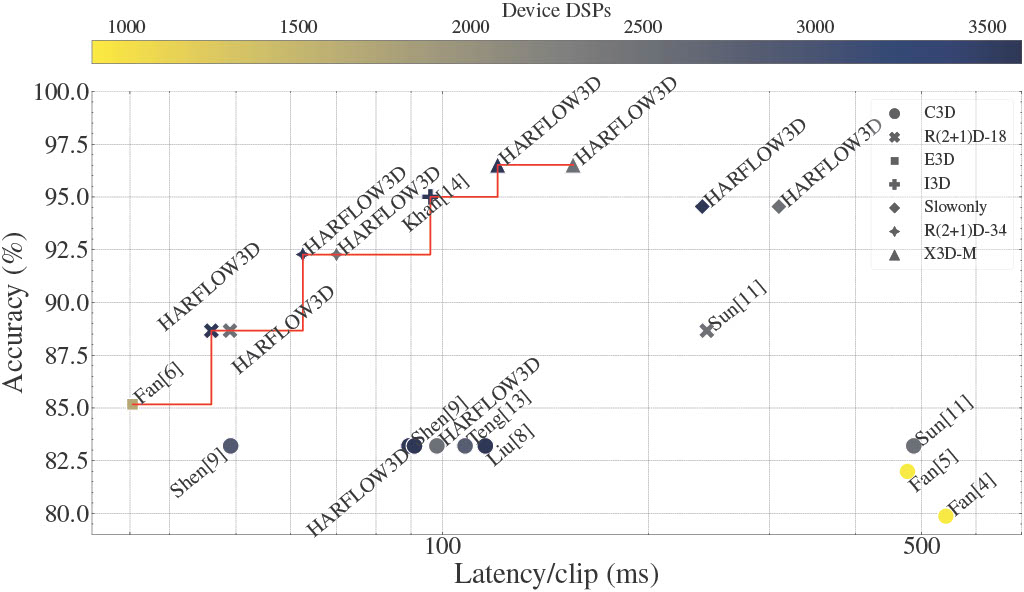
3D convolutional neural networks are among the most accurate models for human action recognition in video, but they are heavy to run. HARFLOW3D is a toolflow that maps such models onto FPGAs with a streaming architecture designed around both the model and the target device.

Read more

It reads a 3D CNN in ONNX format together with a description of the FPGA and generates a design that minimises latency. The flow combines a 3D CNN parser, a performance and resource model, a scheduler for running 3D models on the generated hardware, a resource-aware optimisation engine and an automated route to synthesisable code. Experiments over many model and device pairs show broad support, including 3D CNNs that had never been mapped to FPGAs before, and latency competitive with hand-tuned designs, with up to 5× better performance than some earlier work.
3D CNNsFPGAToolflow
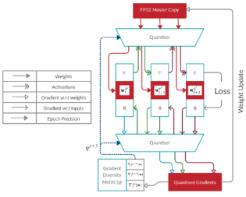
MuPPET multi-precision training architecture

MuPPET: multi-precision policy enforced training

2020–2022 est.

Training large CNNs can take anywhere from hours to weeks, which limits how much practitioners can experiment. Lower-precision arithmetic speeds training up, but accuracy suffers because gradients vanish.

Read more

Existing mixed-precision methods use just two levels, 32-bit and 16- or 8-bit floating point. MuPPET goes further with a multilevel strategy spanning several precisions, including low-precision fixed point, and a run-time mechanism that decides when to switch between them, so training is tailored to the capabilities of the target hardware. Training AlexNet, ResNet18 and GoogLeNet on ImageNet on an NVIDIA Turing GPU, MuPPET matches full-precision accuracy with training up to 1.84× faster, and 1.58× faster on average.

TrainingQuantisationGPU
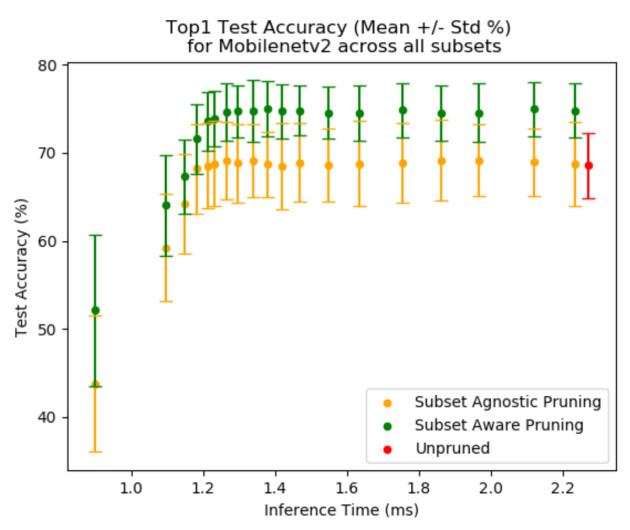
CNN pruning accuracy versus inference time across image subsets

ADaPT: data-driven fine-tuning of CNNs on the edge

2020–2022 est.

Edge devices generate a vast amount of data that could be used to improve the models running on them, but privacy concerns and storage and bandwidth limits keep that data on the device. This project explores fine-tuning CNNs at the edge, adapting both the weights and the topology of a network to the data it actually sees, using structured pruning.

Read more

ADaPT is an extensible open-source framework for deploying such approaches across many network architectures and devices. Data-aware pruning with retraining improves accuracy by 10.2 percentage points on average, and by up to 42.0 points, over pruning that ignores the data being processed.

PruningEdge ML
Caffe Barista FPGA training toolflow

Caffe Barista

2020–2022 est.

The compute needs of deep learning keep growing. Inference on low-power hardware is well studied, but training is far heavier and mostly runs on power-hungry GPUs in data centres.

Read more

Training CNNs on FPGAs is still a young field, mainly because there are few tools for prototyping hardware and algorithmic ideas for power-efficient training. Barista is an automated toolflow that integrates FPGAs into CNN training inside the popular Caffe framework, giving researchers the infrastructure to deploy and test new hardware and algorithm techniques quickly. As far as we know it is the only tool offering this kind of versatile, rapid deployment for FPGA-based CNN training.

TrainingFPGA
CascadeCNN low- and high-precision architecture

CascadeCNN

2018–2020 est.

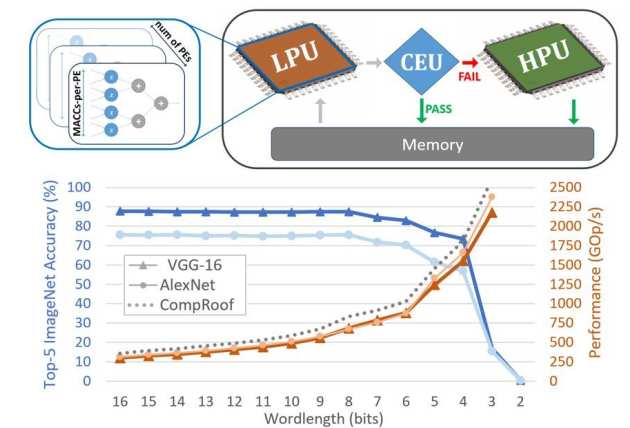
CascadeCNN is an automated toolflow that pushes the quantisation limits of a given CNN, aiming at high-throughput inference by trading computation time against accuracy. For each CNN and FPGA pair it generates a two-stage architecture made of a very-low-precision unit followed by a high-precision unit.

Read more

A confidence evaluation unit between them identifies inputs that the low-precision unit probably misclassified and forwards only those to the high-precision unit for re-processing. For the same resource budget and accuracy, it improves performance by up to 55% for VGG-16 and 48% for AlexNet, without retraining the model or needing access to the training data, which enables extreme quantisation in privacy-constrained settings.

QuantisationFPGA
f-CNNx multi-CNN FPGA architecture

f-CNNx: multi-CNN applications

2018–2020 est.

Complex AI systems increasingly combine several CNNs, each trained for a different subtask with its own throughput and latency needs. Deploying them together is hard: the models compete for the same limited resources, and a one-size-fits-all design ignores their different requirements. f-CNNx is a toolflow that maps multiple CNNs onto a target FPGA while meeting the performance each model needs.

Read more

Starting from pretrained models, it explores a wide range of compute and bandwidth allocations and uses multiobjective cost functions, reflecting how important each model is to the application, to steer the design space exploration towards the best hardware design.

Multi-CNNFPGAToolflow
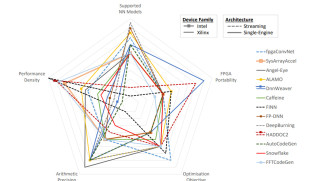
Comparison of CNN-to-FPGA toolflows

Landscape of CNN-to-FPGA toolflows

2018–2020 est.

FPGAs can cut power consumption sharply while still meeting the compute demands of modern deep learning, and a growing number of toolflows automate the mapping of CNN inference onto them. This project surveys that landscape from two viewpoints.

Read more

For deep learning scientists, it studies the supported models (DNNs, CNNs and LSTMs), the processing speed achieved and how well each tool suits applications from latency-critical mobile systems to high-throughput cloud services. For computer engineers, it analyses the architectural choices, design space exploration methods and implementation optimisations. Because existing tools were evaluated in an ad hoc way, the work also proposes a uniform evaluation methodology, backed by a benchmark suite, and outlines future research directions for bringing FPGAs closer to deep learning practitioners.

SurveyBenchmark
Approximate LSTM FPGA computation flow

Approximate FPGA-based LSTMs

2018–2020 est.

LSTMs deliver state-of-the-art accuracy in language and speech tasks, but their computational and memory demands grow with their sophistication. That is a problem for latency-sensitive systems such as mobile robots and autonomous vehicles, which must decide in real time.

Read more

We developed an approximate computing scheme in which an LSTM's accuracy increases with the computation time it is given, together with an FPGA architecture that runs it efficiently. On Google's Neural Image Caption model the framework reaches the same application-level accuracy in 6.65× less time than a baseline, and averages 25× higher accuracy under the same time budget. It is the first work to address deploying LSTMs under computation-time constraints.

LSTMApproximate computing
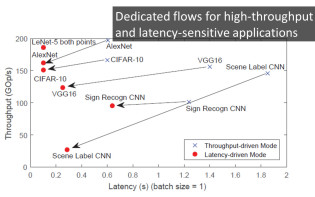
Throughput and latency trade-offs for CNN processing

Latency-driven design for FPGA-based CNNs

2017–2019 est.

Most CNN implementations on CPUs, GPUs and FPGAs are optimised for throughput and rely on batching. Self-driving cars, UAVs and low-response-time cloud services instead need very fast results on single inputs.

Read more

This work puts latency at the centre of the optimisation: a latency-driven methodology generates latency-optimised hardware for each CNN and FPGA pair without batch processing, widening the architectural design space for latency-sensitive applications. It delivers up to 73.54× lower latency for AlexNet and 5.61× for VGG-16 compared with throughput-optimised designs.

LatencyFPGA
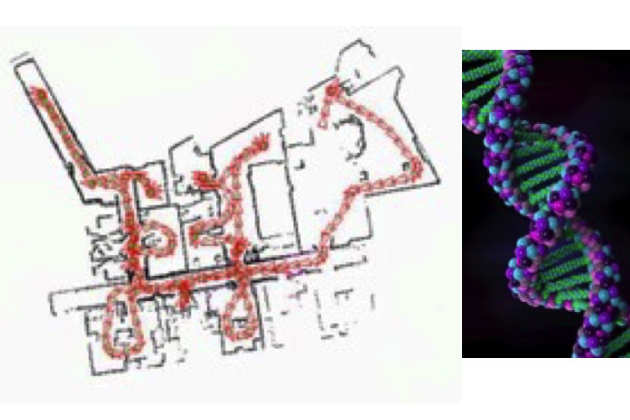
Bayesian inference and robot localisation illustration

Bayesian inference

2005–2007 · 2011–2019 est.

Bayesian inference treats the unknowns in a system as random variables, combining the likelihood of the observed data with prior knowledge to infer the posterior distribution of the parameters. In an era of big data and energy-aware systems, we accelerate the main tools of the field, Markov chain Monte Carlo (MCMC) and sequential Monte Carlo (SMC), and optimise their performance per unit of energy on FPGAs and GPUs.

Read more

Applications include mobile robot localisation and genome analysis.

MCMCSMCBayesian
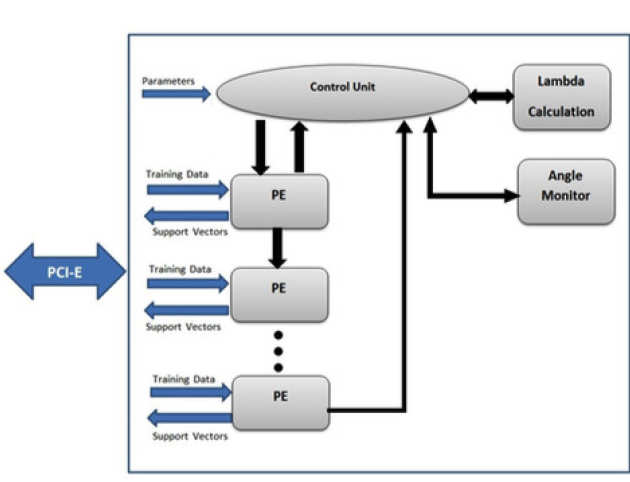
Support vector machine FPGA architecture

Support Vector Machines

2008–2010 · 2013–2018 est.

Support vector machines are a popular supervised learning method with state-of-the-art accuracy, but training them is slow on large problems, which rules them out where a model has to be refined constantly. We accelerate the training stage with an FPGA-based system built on ensemble learning, achieving large speed-ups over CPU and GPU solutions and making it possible to handle big databases and near-real-time adaptive systems.

Read more

We also worked on the classification stage, introducing a cascade classifier based on the word length of the data.

SVMFPGA
Random forest training flow

Random Forests

2013–2015 est.

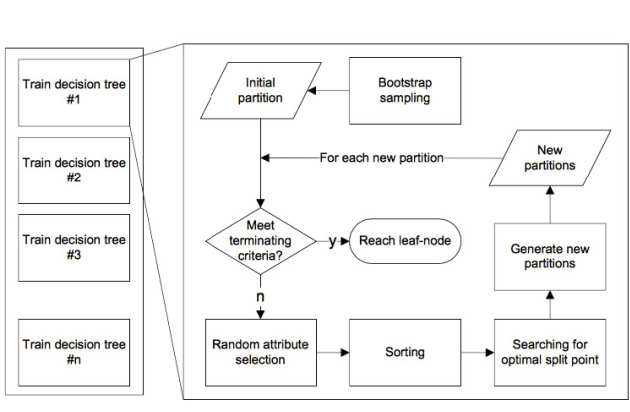
A random forest is an ensemble of decision trees and one of the most widely used supervised learning tools. It generalises better than a single tree and is robust to noise and missing data.

Read more

We accelerate its training stage on FPGAs with a system that handles large problems in batch mode, exploiting the large internal memory bandwidth of modern FPGAs. On a modest FPGA, the architecture reaches a training speed comparable to a GPU with 448 cores and compares well with a Python implementation on a 6-core CPU, with a better performance-to-power ratio in every case.

Random forestsFPGA

Computer Vision 3

Computer Vision
Embedded FPGA architecture for tracking and SLAMSLAM mapping and scene reconstruction results

SLAM on embedded devices with custom hardware

2016–2021 · 2024–2026 est.

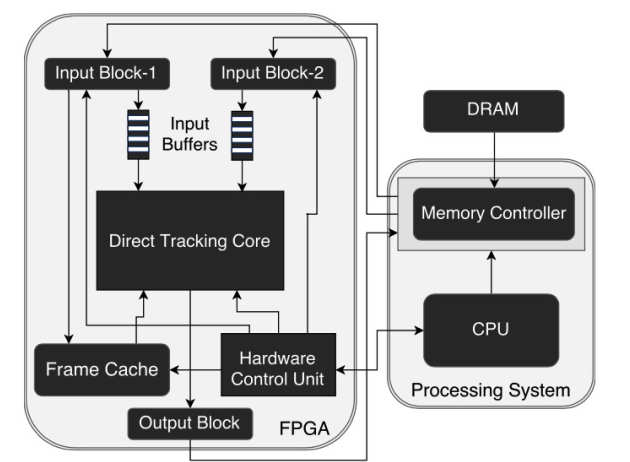
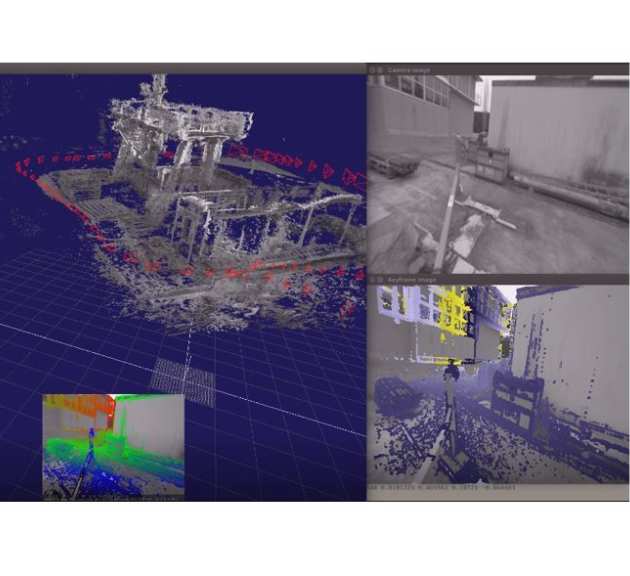
Real-time scene understanding, which fuses real-time vision, object recognition and machine learning, underpins robotics, self-driving cars and AR/VR, yet today's algorithms depend on costly, power-hungry GPUs. We investigate custom, reconfigurable hardware for embedded scene understanding, in particular visual SLAM: the family of algorithms that estimate an observer's position in an unknown environment while building a map of it.

Read more

Our high-bandwidth streaming architectures for tracking and mapping in a semi-dense SLAM algorithm reach state-of-the-art performance with an order-of-magnitude lower power, opening the way for lightweight robots such as UAVs and small ground robots, household and industrial robotics, AR/VR and more power-efficient self-driving cars. SLAMSoC, part of this work, equips small and medium UAVs with SLAM on a hybrid embedded FPGA system-on-chip so they can navigate and eventually interact with unknown environments autonomously. More recent work extends the approach to Gaussian belief propagation accelerators for SLAM.

SLAMFPGA SoCUAVs
Human pose estimation from 3D data

Human pose estimation on embedded systems

2017–2019 est.

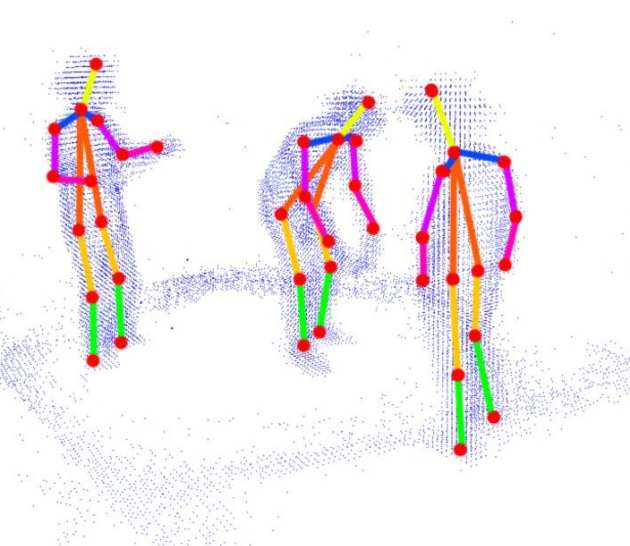
Human pose estimation locates the joints of the body in images or 3D data to reconstruct posture, motion and gestures, and is a long-standing challenge in computer vision. The most accurate methods usually need far more computing power than mobile devices or autonomous robots can offer.

Read more

We are developing a pose estimation framework that combines state-of-the-art accuracy and robust performance in unconstrained settings with an explicit design focus on the limits of embedded hardware. The outcome is a flexible, parameterisable model whose hyper-parameters trade computational complexity against accuracy.

Pose estimationEmbedded
Face super-resolution examples

Face super-resolution

2008–2010 · 2013–2015 est.

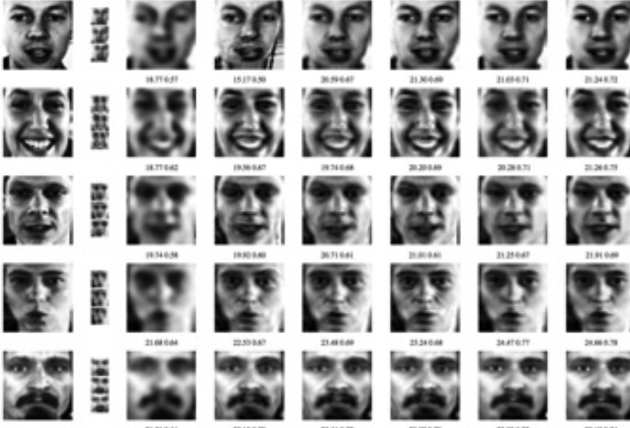
Faces captured from far away are often only 12×12 to 30×30 pixels, too small to track or recognise reliably. Face super-resolution is an active research area, but we take a different view by imposing real-time and low-power constraints from the start, as an embedded system would require.

Read more

By coupling deblurring with registration, our approach outperforms other state-of-the-art methods, and it targets FPGA SoCs and the NVIDIA Tegra K1.

Super-resolutionReal-time

Robotics & UAVs 3

Robotics & UAVs
Indoor UAV navigation environment

Learning to fly by myself

2018–2020 est.

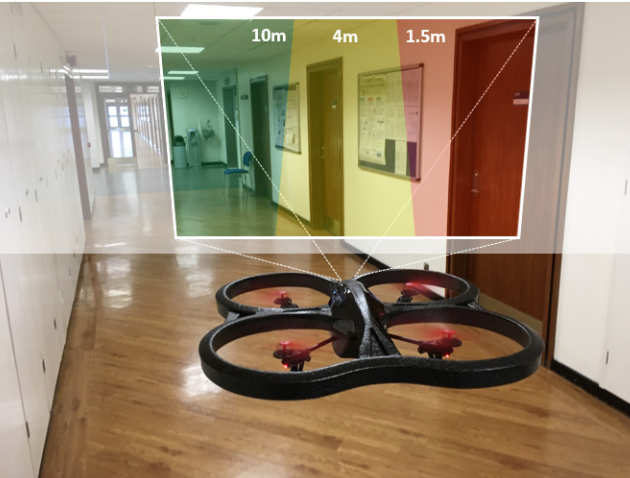
Autonomous navigation is a key enabler for the safe use of drones in civilian applications. We introduce a self-supervised CNN approach to indoor navigation that tackles real-time obstacle avoidance with a regression CNN, which predicts the distance to collision from the raw images of an on-board monocular camera.

Read more

The network is trained on a custom indoor-flight dataset labelled with real distances, collected in a self-supervised manner using external sensors mounted on a UAV. By processing the current and previous frames together, it extracts spatio-temporal features that capture both appearance and motion, estimates the distance to the nearest obstacle in several directions, and uses these estimates to adjust the drone's yaw and forward speed to avoid collisions. In real indoor flights it achieves high accuracy and outperforms earlier published methods (IROS 2018).

Self-supervisedNavigation
UAV-based vehicle detection results

CNN-based real-time object detection on UAV images

2018–2020 est.

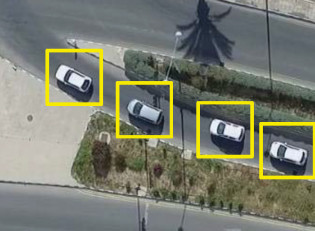
Drones are a promising technology for environmental and infrastructure monitoring, and many applications need computer vision to analyse what the on-board camera sees, for example detecting vehicles for emergency response and traffic monitoring. This project explores the trade-offs in building real-time object detectors based on deep CNNs that stay accurate enough while fitting within the tight resource budget of a UAV. The work includes the DroNet detector and informed region selection for efficient UAV-based detection (IROS 2019).

Object detectionUAVs
UAV ego-motion estimation

UAV ego-motion estimation

2011–2016 est.

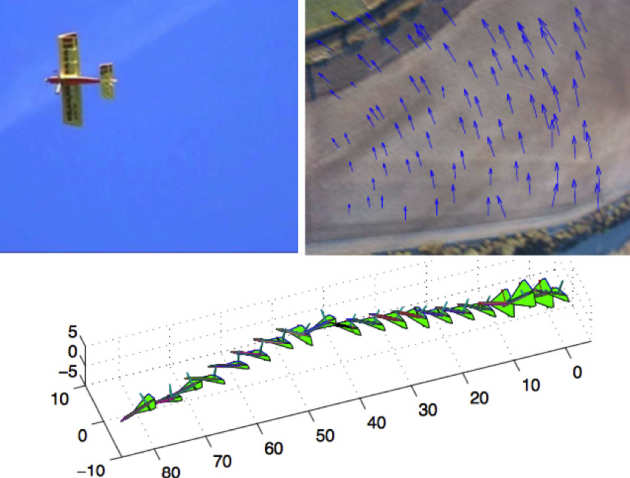
This project develops a system that estimates a plane's ego-motion, its translation and rotation, from the video of a single camera. The challenges are the complexity of the module, hard real-time constraints and robustness to noisy video.

Read more

Success depends on which feature points are selected for extracting the motion parameters: we show that imposing appropriate distance constraints in feature selection markedly improves the precision of the estimates. Using those constraints, we built a real-time FPGA-based ego-motion system that achieves high precision while meeting hard real-time requirements.

Ego-motionFPGA