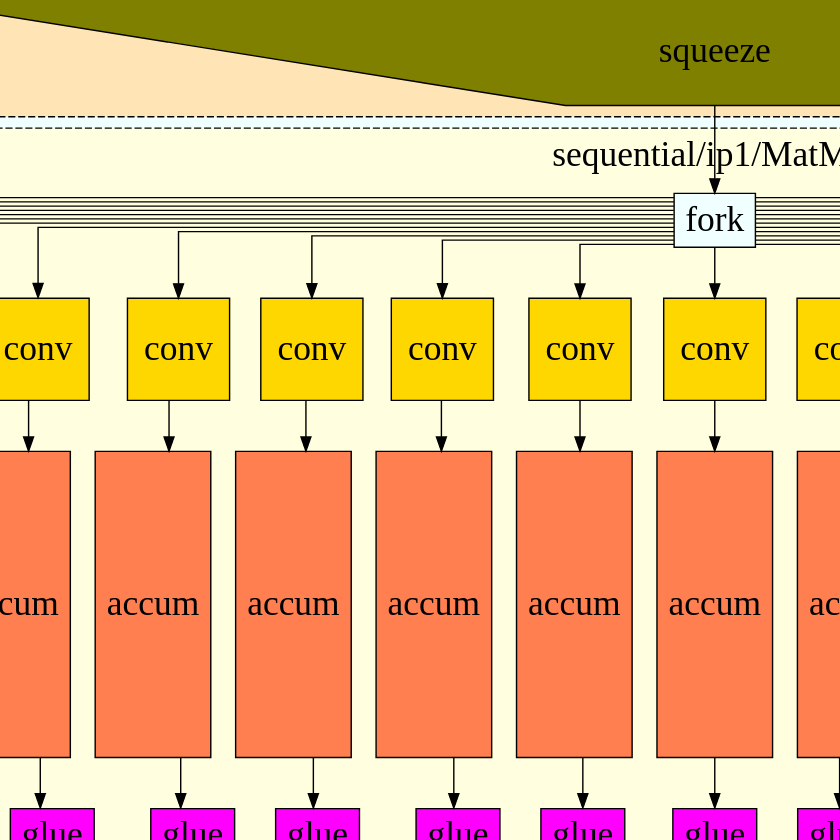
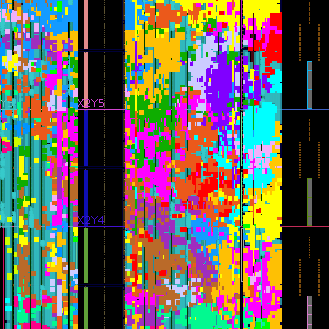
Since the initial conception of the fpgaConvNet toolflow, many research projects have contributed to and used the framework. Its core development has led to innovations in streaming architecture design and in design space exploration, which in turn has enabled novel contributions in several application domains and broadened the scope of the toolflow. The growing list of research outcomes follows.
HASS: Hardware-Aware Sparsity Search for Dataflow DNN Accelerator
FPL 2024Zhewen Yu, Sudarshan Sreeram, Krish Agrawal, Junyi Wu, Alexander Montgomerie-Corcoran, Cheng Zhang, Jianyi Cheng, Christos-Savvas Bouganis, Yiren Zhao
Exploits weight and activation sparsity together with the hardware design space of dataflow accelerators, where the large design space makes approaches built for non-dataflow accelerators inapplicable. fpgaConvNet is used for prototyping.
arXiv
SMOF: Streaming Modern CNNs on FPGAs with Smart Off-Chip
FCCM 2024Petros Toupas, Zhewen Yu, Christos-Savvas Bouganis and Dimitrios Tzovaras
Partially offloading both weights and activations to off-chip memory without penalising the computation pipeline.
arXiv
AutoWS: Automate Weights Streaming in Layer-wise Pipelined DNN Accelerators
DATE 2024Zhewen Yu and Christos-Savvas Bouganis
A memory management methodology for balancing the allocation of weights both on-chip and off-chip.
arXiv
SATAY: A Streaming Architecture Toolflow for Accelerating YOLO Models on FPGA Devices
FPT 2023Alexander Montgomerie-Corcoran, Petros Toupas, Zhewen Yu, and Christos-Savvas Bouganis
Design space optimisations and hardware support for state-of-the-art object detection models.
arXiv
Mixed-TD: Efficient Neural Network Accelerator with Layer-Specific Tensor Decomposition
FPL 2023Zhewen Yu, and Christos-Savvas Bouganis
Tensor Decomposition methods for approximating CNN parameters and improving accelerator performance.
arXiv
fpgaHART: A toolflow for throughput-oriented acceleration of 3D CNNs for HAR onto FPGAs
FPL 2023Petros Toupas, Christos-Savvas Bouganis, Dimitrios Tzovaras
Optimising and mapping state-of-the-art 3D-CNN models for human action recognition (HAR) while aiming for throughput-oriented designs.
arXiv
PASS: Exploiting Post-Activation Sparsity in Streaming Architectures for CNN Acceleration
FPL 2023Alexander Montgomerie-Corcoran*, Zhewen Yu*, Jianyi Cheng, Christos-Savvas Bouganis
this work addresses the challenges associated with exploiting post-activation sparsity for performance gains in streaming CNN accelerators.
arXiv
FMM-X3D: FPGA-based modelling and mapping of X3D for Human Action Recognition
ASAP 2023Petros Toupas, Christos-Savvas Bouganis, Dimitrios Tzovaras
This study bridges the gap between recent developments in computer vision on videos and their deployment and applications on FPGAs by optimising and mapping a state-of-the-art 3D-CNN model (X3D) for human action recognition (HAR).
arXiv
ATHEENA: A Toolflow for Hardware Early-Exit Network Automation
FCCM 2023Benjamin Biggs, Christos-Savvas Bouganis, George A. Constantinides
ATHEENA looks into using early exit networks with fpgaConvNet, and the challenges associated with handling early exit branches.
arXiv
HARFLOW3D: A Latency-Oriented 3D-CNN Accelerator Toolflow for HAR on FPGA Devices
FCCM 2023Petros Toupas*, Alexander Montgomerie-Corcoran*, Christos-Savvas Bouganis, Dimitrios Tzovaras
A new architecture based off of the design principles of fpgaConvNet is developed in this work, but has the benefit of runtime parameter reconfiguration. This makes it suitable for low-latency applications as it avoids the need to do full bitstream reconfiguration, which is necessary for Human Action Recognition (HAR).
arXiv
SAMO: Optimised Mapping of Convolutional Neural Networks to Streaming Architectures
FPL 2022Alexander Montgomerie-Corcoran*, Zhewen Yu* and Christos-Savvas Bouganis
This work builds on the capabilities of fpgaConvNet's design space exploration, by proposing two optimisers (simulated annealing and rule-based), as well as expanding the scope to other FPGA-based ML accelerator frameworks, namely FINN and HLS4ML.
DOI
StreamSVD: Low-rank Approximation and Streaming Accelerator Co-design
FPT 2021Zhewen Yu and Christos-Savvas Bouganis
This work looks into methods of compressing ML models by using Singular Value Decomposition (SVD) to reduce the number of weight parameters required. fpgaConvNet was used to show how this method benefits ML accelerators.
IEEE Xplore
DEF: Differential Encoding of Featuremaps for Low Power Convolutional Neural Network Accelerators
ASP-DAC 2021Alexander Montgomerie-Corcoran and Christos-Savvas Bouganis
In this paper, a novel coding scheme is introduced which exploits the properties of feature maps to reduce the activity along off-chip memory data busses, leading to lower system power consumption.
DOI
Power-Aware FPGA Mapping of Convolutional Neural Networks
FPT 2019Alexander Montgomerie-Corcoran and Christos-Savvas Bouganis
This work explores the power consumption aspect of fpgaConvNet, producing high-level models of how design choices affect the power consumption of the accelerator.
DOI
fpgaConvNet: Mapping Regular and Irregular Convolutional Neural Networks on FPGAs
TNNLS 2018Stylianos I. Venieris and Christos-Savvas Bouganis
DOI
Latency-Driven Design for FPGA-based Convolutional Neural Networks
FPL 2017Stylianos I. Venieris and Christos-Savvas Bouganis
DOI
fpgaConvNet: A Framework for Mapping Convolutional Neural Networks on FPGAs
FCCM 2016Stylianos I. Venieris and Christos-Savvas Bouganis
IEEE Xplore